I had the privilege of being a contributor to the newly-released book Castles, Customs, and Kings, a compilation of essays from the English Historical Fiction Authors blog by more than fifty authors on real life stories and tantalizing tidbits discovered while doing research for their books. You can buy the book here: http://www.amazon.com/Castles-Customs-Kings-English-Historical-ebook/dp/B00FCEJ10Y/ref=la_B003VQF4CO_1_2?s=books&ie=UTF8&qid=1397926831&sr=1-2
Today, many of these authors are participating in a blog hop, each writing a post related to castles and giving away a historical novel.
My subject today is Codnor Castle in Derbyshire.
Bess of Hardwick, one of the most interesting and striking figures of the Tudor era, who ended up the most wealthy and powerful woman in England after Queen Elizabeth, began life inauspiciously. Her father had died when she was a baby, her mother remarried, and by the time Bess was twelve years old, her stepfather was in debtor's prison and her mother was struggling to raise the five children still at home. The crown had seized control of the estate upon the death of Bess's father, until her brother James came of age. Bess's mother was entitled to a widow's dower of a third of the proceeds from the estate and to lease another third of the land, and she must have despaired of how she could keep from losing the family's property.
One thing she could do was to ensure that her daughters had a chance at a better life, and this she did by sending them off to serve as ladies in waiting in the households of distant relatives who were better off. This was a common way for young people to meet potential mates and influential patrons who would help them rise in the world.
When Bess was about twelve years old, she went to serve Anne Gainsford, Lady Zouche, at Codnor Castle, about twelve miles from her home at Hardwick.
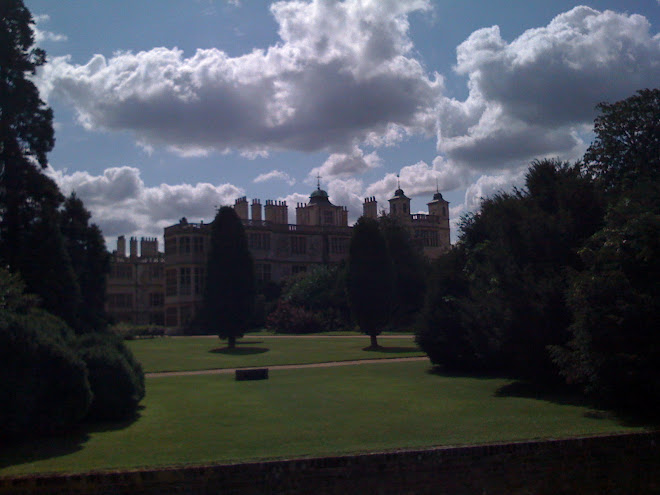
There was probably a fortified on the site soon after the Norman invasion. The Codnor Castle that Bess knew was built in the thirteenth century and was the seat of the powerful De Grey family for about three hundred years, but in the fifteenth century, it passed to the Zouche family through marriage. The castle grew and transformed over the year, and by the time Bess arrived there in about 1539, it no longer served its original purpose as an armed fortress, but it still retained imposing round towers with battlements and a moat. Outbuildings that served the estate such as the brewery, bakery, and dairy no longer had to be within the protective walls of the castle but had spilled outside to the south courtyard.
Bess's mistress Lady Zouche and her husband Sir George Zouche had served in the household of Anne Boleyn before she became queen. They managed to stay in the good graces of King Henry VIII, and in about 1540 Sir George became one of the king's Gentlemen Pensioners, the prestigious few men chosen to guard the king and remain in his company both at court and during his summer progresses around the country. In this position, he would have had to spend much time in London.
Bess's service in the Zouche household certainly set her on the path to success, and in my novel Venus in Winter, based on the first forty years of Bess's long and eventful life, I chose to have Bess accompany the Zouche familiy to London in time for Bess to witness the king's marriage to Anne of Cleves and the resulting upheavals.
Today, Codnor Castle is one of only two castles in Derbyshire retaining its original medieval architecture, thought only ruins are left of the three-story keep, curtain wall, and ditch, flanked by round towers.
Post a comment on this post to enter to win a copy of the mass-market paperback edition of The Darling Strumpet, my five-star rated novel about Nell Gwynn! Tweet or post the link to the post for extra entries!
Below are links to some sites with more information about Codnor Castle, and to the other blogs on the blog hop.
http://www.codnorcastle.com/gallery/g2embed.php?g2_itemId=448
http://www.codnorcastle.com/
http://www.codnorcastle.co.uk/index.html
.
Sunday, September 22, 2013


Sunday, June 9, 2013
Summer Banquet Hop Winners!
Congratulations Grace Elliot and History Writer - you're the winners! Email me your mailing addresses please (gillianbagwell@hotmail.com), and whether you'd like the mass market paperback of "The Darling Strumpet" (with excerpt from "Venus in Winter") or "Venus in Winter" (which I will have in a week or two!)
Sunday, June 2, 2013
Summer Banquet Hop! Enter to Win!

Summer Banquet Hop!
Join me and thirty other historical novelists for a bounty of food-related
posts and chances to win prizes!
I'm giving away two
prizes: a copy of The Darling Strumpet, released in mass-market paperback on June
4, with a teaser chapter of Venus in
Winter, or a copy of Venus in Winter, my novel based on
the first forty years of the eventful life of the Tudor dynast Bess of Hardwick,
coming July 2!
Enter by leaving a comment on this post. Get extra entries
by following me on Twitter https://twitter.com/GillianBagwell and/or for liking my Facebook
author page: https://www.facebook.com/gillianbagwell
The Darling Strumpet
“An absolute triumph as a debut novel . . . [It] is an absolutely
brilliant addition to the historical fiction genre and might be the best novel
on Nell Gwynn ever . . . Nell would have applauded in approval and probably
done a little jig to celebrate her tribute.” — Pittsburgh Historical Fiction
Examiner
Venus in Winter
“A wonderful portrait of one of Elizabethan England’s most
fascinating—and most long-lived—women. A great read, rich with detail and story.”—Diana Gabaldon, author of
the bestselling Outlander seriesNell Gwynn, the subject of my novel The Darling Strumpet, was born in the slums of London in the area of Covent Garden. At the age of thirteen, she was hired as an orange seller at the newly-built Theatre Royal in Bridges Street, which opened on May 7, 1663. The present Theatre Royal on Drury Lane is the third building on the same site.
Oranges were a delicacy, and sold for sixpence, as much as
the cheapest seats in the theatre. Nell’s witty banter and likeable sex appeal
got her noticed, and soon she was the lover and protégé of Charles Hart, one of
the leading actors and shareholders of the King’s Company. She probably made
her debut in Thomas Killigrew’s comedy Tomaso,
in a small part as a saucy wench. Nell rapidly became a favorite of London
audiences, and she and Hart appeared in a series of “gay couple” comedies
featuring battling lovers, making them the Myrna Loy and William Powell of the
Restoration theatre.
Here’s a delightful
seventeenth-century recipe featuring oranges:
Orange Butter
Good with plain cookies, on ice cream, etc. From A Taste
of History: 10,000 Years of Food in Britain, which took the recipe from The Savile Recipe Book, 1683, quoted in The Gentlewoman’s Kitchen.
¼ pint (150 ml) fresh orange juice, and thinly peeled zest of the
oranges
¼ point (150 ml) white wine6 egg yolks
2 T. (30 ml) sugar
Soak the zest in the orange juice and white wine for 30 minutes to enrich the flavor, then remove. Beat the eggs yolks and sugar and add to the orange juice. Pour the mixture into a saucepan and stir continuously over a low heat until thick and creamy, but do not allow to bring to a boil. Allow the butter to cool and serve with wafers as a rich full-flavored fruit dip.
The original recipe:
R. a quarter of a Pint of cleared juice of Oranges, a quarter of a Pint of white wine, pare the Peel of your Oranges thinne, steep itt in the juice & white-wine halfe an hour, then put in when you have taken out the pill a little fine Sugar, to take away the sharpnesse. Then beat the yolks of six eggs very well, & put them into the liquor, & sett them over the fire, & keep itt continually stirring till you find it almost as thick as Butter then throw it about the dish or bason, & let itt stand all night, in the morning take itt off lightlie with a spoon, & serve itt as other Butter.
For more on my books and events,
please visit my website, www.gillianbagwell.com!
Be sure to visit the blogs of the other authors participating in the Summer Banquet Hop! Hop Participants
- Random Bits of Fascination (Maria Grace)
- Pillings Writing Corner (David Pilling)
- Anna Belfrage
- Debra Brown
- Lauren Gilbert
- Gillian Bagwell
- Julie K. Rose
- Donna Russo Morin
- Regina Jeffers
- Shauna Roberts
- Tinney S. Heath
- Grace Elliot
- Diane Scott Lewis
- Ginger Myrick
- Helen Hollick
- Heather Domin
- Margaret Skea
- Yves Fey
- JL Oakley
- Shannon Winslow
- Evangeline Holland
- Cora Lee
- Laura Purcell
- P. O. Dixon
- E.M. Powell
- Sharon Lathan
- Sally Smith O'Rourke
- Allison Bruning
- Violet Bedford
- Sue Millard
- Kim Rendfeld
Saturday, April 27, 2013
POV Panel April 28 at California Writers' Club
Hi, all,
My friend Patricia Bracewell and I will be talking about point of view at the meeting of the California Writers' Club at Book Passage, tomorrow, Sunday, April 28, 2-4 p.m. We met for quite a while this morning to plot!
http://cwcmarin.com/events/apr-28-point-of-view/
My friend Patricia Bracewell and I will be talking about point of view at the meeting of the California Writers' Club at Book Passage, tomorrow, Sunday, April 28, 2-4 p.m. We met for quite a while this morning to plot!
http://cwcmarin.com/events/apr-28-point-of-view/
Thursday, November 8, 2012
The Next Big Thing!
Hi, friends,
After I finished my second book, The September Queen (U.K. title The King’s Mistress), I was casting about for a new subject and recalled that I had thought Bess of Hardwick sounded like an interesting historical character, though I didn’t know much about her. Just from reading the Wikipedia entry on her, I was hooked!
What genre does your book fall under?
Historical fiction.
Bess second husband, William Cavendish, was a member of the privy council, and her third husband, William St. Loe, was captain of the queen’s guard. Elizabeth probably owed him her life for not betraying her shadowy involvement in the Wyatt Rebellion, and partly in thanks, she made Bess a lady of her privy chamber. Shortly after Bess married her fourth husband, the Earl of Shrewsbury, they were put in charge of Mary Queen of Scots – which contributed to the ruin of their marriage.
I've been tagged in The Next Big Thing by fellow writer Isabelle
Goddard (http://www.isabellegoddard.com/isabelle-goddard.html),
author of Regency romances, who I had the pleasure of meeting at the Historical
Novel Society conference in London in September.
I'm instructed to tell you all about my next book by answering
these questions and then to tag a few other authors about their Next Big Thing.
So here I go!
What is the working title of your
next book?
Venus in Winter.
Where did the idea come from for the book?After I finished my second book, The September Queen (U.K. title The King’s Mistress), I was casting about for a new subject and recalled that I had thought Bess of Hardwick sounded like an interesting historical character, though I didn’t know much about her. Just from reading the Wikipedia entry on her, I was hooked!
What genre does your book fall under?
Historical fiction.
Which actors would you choose to play your characters in a movie
rendition?
My book runs from Bess’s twelfth birthday
to her fortieth (she lived to 80), so there would have to be a young girl for
the first scenes and another actress to portray her in adulthood. Michelle
Dockery (Lady Mary Crawley from Downton
Abbey) has the right strength and presence, though Bess was a fair-skinned,
blue-eyed redhead! Jessica Chastain looks right and is a very good actress.
What is the one-sentence synopsis of your book?
A sweeping and romantic
novel of Bess of Hardwick, the formidable four-times widowed Tudor dynast who
began life in genteel poverty and ended as the richest and most powerful woman
in England after Queen Elizabeth; built Chatsworth House and Hardwick Hall; and
is the forebear of numerous noble lines including the current royal family of
Britain.
Will your book be self-published or represented by an agency?
My book will be published by Berkley, a division of Penguin, who
published my first two books.
How long did it take you to write the first draft of your
manuscript?
Writing this book was rather a nightmare
process. I had less than year from when the deal was made until I had to turn
in the manuscript to the publisher. Like my other books, it has required an
enormous amount of research. I started writing in late July 2011 and finished
the first draft at the end of April 2012.
What other books would you compare this story to within your genre?
Biographical historical fiction of the
type written by Margaret George and C.W. Gortner.
What else about your book might pique the reader's interest?
Bess knew everyone who was anyone
throughout the Tudor period. At the age
of twelve she began serving Lady Zouche, who had been a lady in waiting to Anne
Boleyn and Jane Seymour, and she was probably at court beginning around the
time that Henry VIII married Anne of Cleves. When she was about 15 she joined
the household of the Marchioness of Dorset, Frances Grey, and was close to
Frances’s daughters – Lady Jane Grey and her younger sisters Katherine and
Mary. Bess second husband, William Cavendish, was a member of the privy council, and her third husband, William St. Loe, was captain of the queen’s guard. Elizabeth probably owed him her life for not betraying her shadowy involvement in the Wyatt Rebellion, and partly in thanks, she made Bess a lady of her privy chamber. Shortly after Bess married her fourth husband, the Earl of Shrewsbury, they were put in charge of Mary Queen of Scots – which contributed to the ruin of their marriage.
Here are some lovely authors I've tagged to tell you about their
Next Big Thing! I had the pleasure of meeting all
of them at the Historical Novel Society Conference in London in September, and
like me, they all write about seventeenth century England! Their posts will be
out on November 15!
Deborah Swift, whose most recent book The Gilded Lily, has just come out. http://www.deborahswift.blogspot.com
J.D. Davies is the author of the Matthew Quinton series, the first of which
is Gentleman
Captain. Excellent swashbuckling naval tales set during the Restoration
era.
http://gentlemenandtarpaulins.com
Anita Davison, whose book Royalist Rebel will be out soon!
http://thedisorganisedauthor.blogspot.comWednesday, November 7, 2012
Next Big Thing post coming soon!
Things are a bit behind here in Nell Gwynn land, but shortly I'll post my leg of the Next Big Thing blog marathon!
Tuesday, August 14, 2012
A plug from Diana Gabaldon!
There's nothing about Diana Gabaldon that I don't like. I love her books, her humor, how she became such a successful author after a career in science. And I love her generosity. Yesterday she posted on her Facebook page an little story about how we came to read a scene from The Darling Strumpet at the Historical Novel Society Conference last June - and a link to the video on You Tube, which is now up to more than 11,500 hits!
https://www.facebook.com/#!/AuthorDianaGabaldon
https://www.facebook.com/#!/AuthorDianaGabaldon
Subscribe to:
Posts (Atom)